
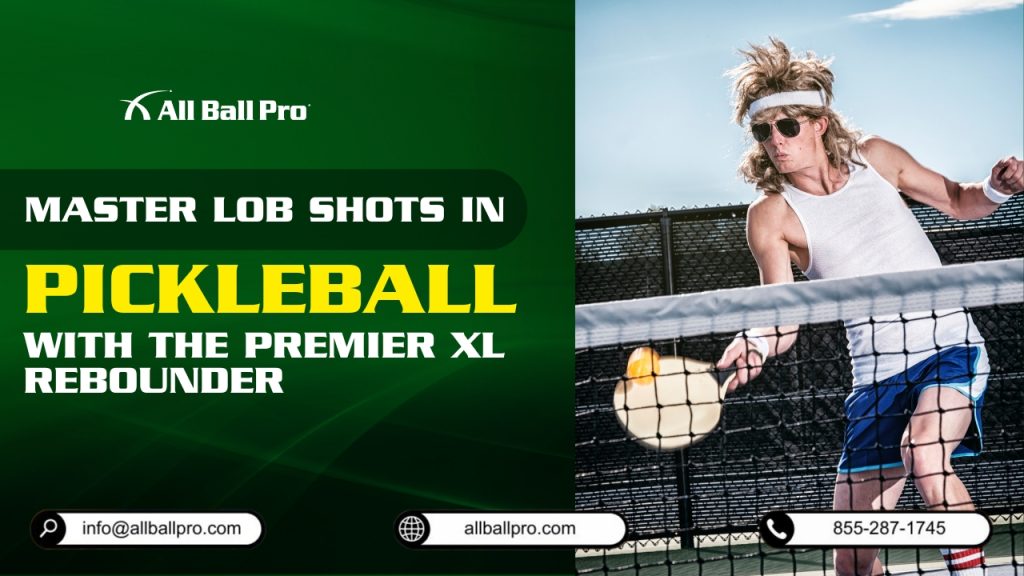
Lob shots in pickleball require timing, precision, and a good understanding of your paddle control. These high-arching shots are essential in pickleball, as they can be an effective way to catch your opponent off guard, sending them scrambling to the back of the court. However, mastering the lob shot is challenging and requires practice with the right equipment. Using tools like The Premier XL Rebounder by All Ball Pro can help you improve your accuracy and consistency, allowing you to practice solo while focusing on key skills. In this article, we will go over practical drills for lob shots that you can perform with a rebounder, breaking down each step to enhance your technique and confidence.
Drill 1: Setting Up with The Premier XL Rebounder
To get the most out of your training, start by positioning The Premier XL Rebounder at the optimal angle to replicate realistic return shots. Begin with the rebounder at a slight incline to simulate the angle of an opponent’s return. This drill will help you focus on refining the height and control needed for successful lob shots.
- Position the Rebounder – Set up the rebounder at a 45-degree angle, around 10 feet from your stance, to simulate the arc of a return. Adjust it as needed based on your comfort level.
- Start with Controlled Lobs – Begin by hitting soft, controlled lob shots toward the rebounder. Aim to make contact just below the center of the rebounder to achieve an upward trajectory.
- Focus on Consistency – Repeat this process ten times, aiming for consistent height and placement. Check if the rebounder’s return shot lands within a predictable area.
- Adjust Your Angle – To increase the challenge, adjust the angle slightly to change the rebound trajectory. This simulates the unpredictability of a live game.
- Monitor Your Form – Ensure that your posture remains stable and that your swing motion is smooth. Avoid overextending your arm or leaning too far back, which can lead to an imbalanced shot.
- Repeat and Review – After a round of lobs, pause to review what adjustments improved your control, then repeat the drill.
Drill 2: Perfecting the Lob Arc
Once you’re comfortable with basic lobs, the next drill focuses on perfecting the arc of your shot, which is crucial for achieving the ideal height and distance.
- Set Your Target – Place a target on the rebounder to help you visualize where your lob should hit for maximum arc. Use markers to guide your aim on the rebounder’s surface.
- Focus on Wrist Control – As you aim, focus on flicking your wrist at the point of contact. This motion will help generate the height you need without excessive power.
- Adjust for Height – Gradually increase the height of your lob by aiming slightly higher on the rebounder with each shot. Practice maintaining control as you adjust the arc.
- Use Different Paddles – Experiment with different paddles to see how the weight and size impact the arc. This will help you identify your preferences for game-day conditions.
- Monitor Rebound Distance – Watch where the rebound lands. The ideal lob should land deep on the opposite side of the court, allowing time for repositioning.
- Evaluate and Adjust – Check if your shots are too low or if they’re reaching the desired height. Make small adjustments to your swing as needed.
Drill 3: Practicing Depth Control
The depth of a lob shot can make a big difference, especially when your opponent is positioned close to the net. This drill will help you gain control over how deep your lob shots land on the opposite side.
- Mark Depth Zones – Use tape to mark depth zones on the court. Aim for the zones farthest from the net to practice deep lobs.
- Control Power and Angle – Adjust your shot’s power while maintaining a smooth swing to target each zone. This helps you control depth without sacrificing arc.
- Track Consistency – Keep a tally of how many shots hit each depth zone to monitor your consistency. Aim to increase accuracy with each round.
- Vary Your Starting Position – Practice lobbing from different points on the court to simulate real-game scenarios.
- Use Visual Cues – Focus on a spot above the rebounder to help gauge how much power is needed for deeper lobs.
- Analyze and Improve – After each set, assess which shots were most accurate and try to replicate that form.
Drill 4: Adding Side Spin
A lob with a slight side spin can add complexity to the shot, making it harder for opponents to anticipate. This drill will guide you in adding side spin to your lob shots.
- Grip Adjustment – Start with a looser grip to increase flexibility in your wrist, allowing for a gentle flick that creates spin.
- Aim at the Side of the Rebounder – Hit the side edge of the rebounder to practice directing the shot with spin.
- Practice Wrist Flick – Flick your wrist to the side as you make contact with the ball. This movement will add a subtle spin to the shot.
- Monitor Spin Effect – Watch how the rebounder returns the ball to understand how much spin affects the shot’s direction.
- Control Spin Power – Begin with a light flick and gradually increase the spin. Observe how the ball curves, then make adjustments to achieve control.
- Repeat with Different Spins – Practice adding spins in various directions to develop versatility.
Drill 5: Speed Variation in Lobs
Mastering the ability to vary your lob shot’s speed is valuable for keeping opponents guessing. This drill helps you practice adding or reducing power on demand.
- Start with Soft Lobs – Begin with softer, slower lobs to develop a gentle touch, focusing on control rather than power.
- Gradually Increase Power – Add power incrementally, observing how the ball interacts with the rebounder and aiming to land further each time.
- Switch Between Slow and Fast – Practice alternating between soft and powerful lobs to develop flexibility and adaptability.
- Watch Rebounder Returns – Take note of how different speeds impact the rebound angle, and use this to predict how the shot will play out on the court.
- Focus on Arm Strength – Work on building strength in your forearm, as this will help maintain control when adding speed to your lob.
- Refine Your Timing – Adjust the timing of your wrist flick to gain full control over each speed variation.
Drill 6: Testing Reaction Time
Quick reaction time is essential for effective lob shots, especially when faced with unpredictable returns. This drill challenges your reflexes and prepares you for fast-paced play.
- Stand Closer to the Rebounder – Position yourself closer than usual to simulate a fast-paced return.
- Rapid-Fire Lob Practice – Hit a series of rapid lobs against the rebounder, focusing on responding quickly to each return.
- Increase Repetition – Do a set of 20 lobs at a faster pace, keeping your eyes on the rebound to anticipate where the next shot will land.
- Use Shorter Strokes – Use compact, controlled strokes to reduce reaction time and improve shot accuracy.
- Watch for Patterns – Look for patterns in the rebound to better anticipate returns and adjust your stance as needed.
- Challenge Yourself with Speed – Increase your speed in each set to push your reaction capabilities further.
Practicing lob shots consistently with a reliable rebounder helps you gain control, precision, and confidence. Each drill is designed to target a specific aspect of lob shots, from controlling the depth and arc to varying speed and adding spin. All Ball Pro Rebounders offer players the consistency they need to work on these skills solo, creating a realistic practice environment that translates well to actual games. Incorporating these drills into your practice routine will make your lob shots more reliable and effective, giving you a strategic edge on the court.