
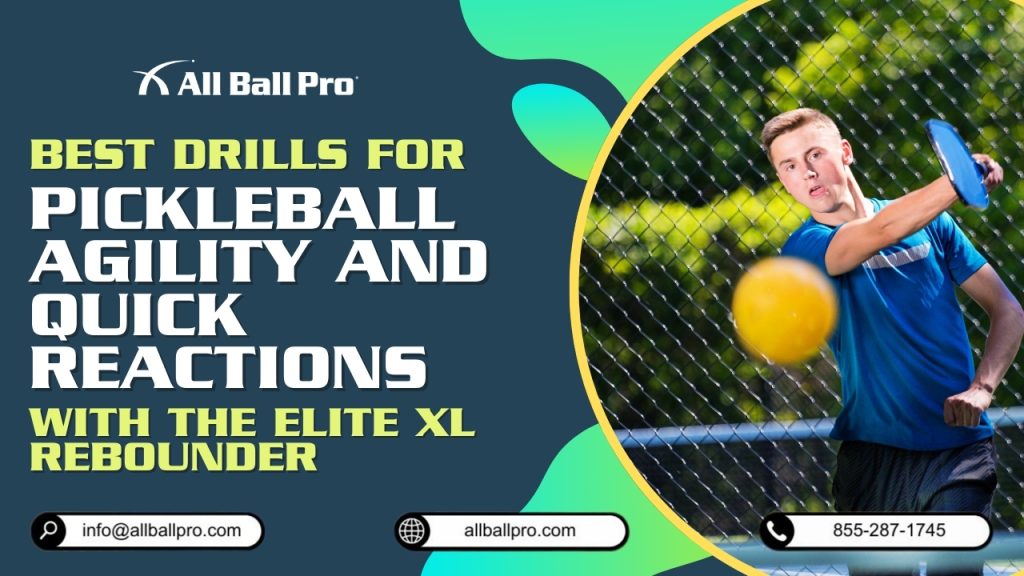
Pickleball is an exciting and fast-paced game that demands agility, quick reactions, and precise coordination. Whether you are a beginner or an experienced player, sharpening these skills is essential to enhance your performance on the court. Incorporating tools like The Elite XL Rebounder by All Ball Pro into your practice routine can elevate your training, offering dynamic ways to improve your speed and reflexes. In this article, we will explore the best drills to boost your agility and reaction time, complete with step-by-step instructions to get you moving faster and more confidently.
1. Reaction Wall Drill with The Elite XL Rebounder
Using The Elite XL Rebounder is a simple yet highly effective way to develop your reaction speed. This Pickleball rebounder mimics unpredictable ball returns, forcing you to stay alert and adapt quickly.
- Set up the rebounder: Position The Elite XL Rebounder about 6-8 feet from you at an angle that replicates typical Pickleball returns.
- Begin with volleys: Use your paddle to hit the ball against the rebounder and prepare to return it as it bounces back. Focus on maintaining a controlled rhythm.
- Incorporate variation: Change your hitting angles and speed to simulate game scenarios. This keeps the drill dynamic and challenges your reaction time.
- Alternate hands: Switch between forehand and backhand volleys to improve versatility and strengthen both sides of your play.
- Track your progress: Time yourself for one-minute intervals and count the successful returns. Aim to improve with each session.
- Adjust difficulty: Move closer or farther from the rebounder to increase or decrease the reaction challenge.
This drill encourages quick decision-making and keeps your movements sharp, essential for returning fast shots during a match.
2. Side-to-Side Agility Shuffle
Building lateral agility helps you cover the court more effectively, especially when responding to cross-court shots.
- Mark your space: Place two markers or cones about 10 feet apart on the court.
- Position yourself: Stand in a ready position at one cone with your knees slightly bent and your paddle up.
- Start shuffling: Move laterally to the opposite cone as quickly as possible, staying low and balanced.
- Incorporate a ball: Bounce a ball off the rebounder at each end to simulate hitting and receiving. Strike the ball as you reach each marker.
- Increase intensity: Gradually increase your speed as you become more comfortable with the drill.
- Time your drills: Perform this exercise for 30-second intervals, rest for 15 seconds, and repeat for 4-5 sets.
Practicing this drill improves your lateral quickness, a vital skill for responding to unpredictable shots.
3. Drop Shot Precision Drill
Drop shots are a crucial part of Pickleball strategy, and this drill helps improve your touch and accuracy.
- Set up the rebounder: Position the rebounder about 8 feet in front of you.
- Practice soft returns: Hit the ball against the rebounder with minimal force, aiming for a gentle, controlled return.
- Focus on placement: Target specific areas on the rebounder to refine your precision. Visualize dropping the ball just over the net during a game.
- Change angles: Adjust your position relative to the rebounder to practice different shot trajectories.
- Add movement: Shuffle side-to-side between shots to mimic real game scenarios where drop shots require quick repositioning.
- Repeat consistently: Perform 10-15 reps per set and aim for three sets per session.
This drill sharpens your ability to execute soft, well-placed shots, a key tactic in winning rallies.
4. Split-Step Reaction Drill
The split-step is a foundational movement in Pickleball, allowing you to react quickly and move efficiently.
- Start with the rebounder: Position the Pickleball rebounder 6-10 feet in front of you.
- Practice the split-step: Begin in a ready stance. As the ball comes off the rebounder, perform a small hop and land on the balls of your feet, ready to move in any direction.
- React to the ball: Move toward the ball and return it, focusing on quick, explosive movements.
- Alternate returns: Use a mix of forehand and backhand shots to keep the drill varied.
- Maintain form: Keep your core engaged and knees bent throughout to ensure proper technique.
- Progressively challenge yourself: Gradually reduce the reaction time between the split-step and your return to improve speed.
This drill helps condition your body to respond instinctively, giving you an edge in high-pressure situations.
5. Reflex Volley Drill
Quick reflexes are essential for returning fast volleys. This drill focuses on honing your paddle skills and hand-eye coordination.
- Set up the rebounder: Position it about 5 feet from your ready position.
- Begin volleying: Hit the ball against the rebounder and prepare to return the rapid rebound. Keep your paddle steady and controlled.
- Increase speed: Gradually hit the ball harder to simulate fast-paced exchanges.
- Focus on control: Avoid overhitting and concentrate on maintaining a consistent rhythm.
- Add variability: Use different paddle angles to change the ball’s trajectory and challenge your reflexes further.
- Time your sessions: Perform the drill for 1-minute bursts with a 20-second rest between rounds. Aim for 5-6 rounds per session.
This exercise develops the quick reaction times needed to excel during fast volley exchanges.
6. Quick Pivot Footwork Drill
Pivoting effectively allows you to stay balanced and adjust to shots without losing your footing.
- Position yourself: Stand near the rebounder with your feet shoulder-width apart.
- Initiate pivots: As the ball returns from the rebounder, pivot your feet to align with the ball’s direction.
- Strike and reset: Hit the ball and immediately return to a neutral position, ready for the next shot.
- Change directions: Practice both clockwise and counterclockwise pivots to improve versatility.
- Speed up: Gradually quicken your pivoting motions to match game-like conditions.
- Track improvement: Count the number of successful pivots and returns in one minute. Strive to increase this number over time.
Consistent practice of this drill enhances your footwork and ensures you stay agile during gameplay.
7. Agility Circuit Challenge
Combine multiple drills into a circuit to create a comprehensive agility workout.
- Design your circuit: Choose three drills, such as the Reaction Wall Drill, Side-to-Side Shuffle, and Reflex Volley Drill.
- Set a timer: Allocate 1 minute per drill with a 30-second rest between each.
- Perform the circuit: Execute each drill in sequence, focusing on speed, accuracy, and consistency.
- Repeat rounds: Complete 3-4 rounds of the circuit for a full workout.
- Evaluate performance: Note areas where you’re excelling and those that need improvement.
- Challenge yourself: As you progress, increase the intensity or duration of each drill to push your limits.
This circuit ensures a well-rounded workout that targets agility, reaction time, and coordination all at once.
Incorporating these drills into your routine is a great way to enhance your Pickleball skills and overall athleticism. Tools like All Ball Pro Rebounders provide valuable versatility, helping you practice in dynamic and realistic ways. Whether it’s perfecting your volleys with The Elite XL Rebounder or boosting lateral quickness with the agility shuffle, these exercises are designed to elevate your game. Remember to track your progress and stay consistent with your practice. Over time, these drills will not only improve your reaction speed but also build your confidence on the court. By integrating these methods, you’ll be well-prepared to face any challenge in your Pickleball matches.