
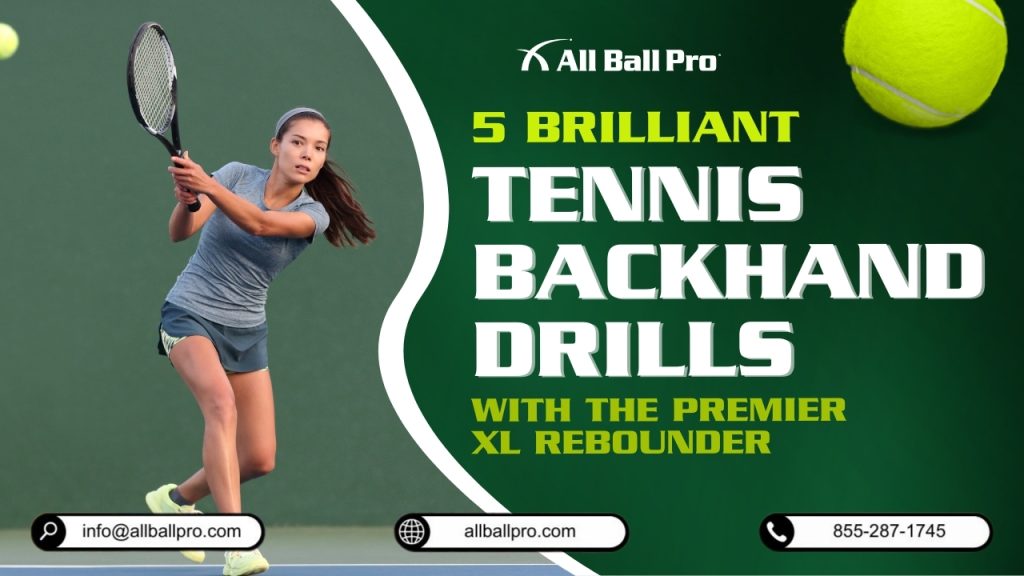
Tennis is a sport that demands precision, agility, and finesse. To excel on the court, players must continuously refine their skills through focused training. The Premier XL Rebounder by All Ball Pro, a versatile and powerful training tool, provides tennis enthusiasts with an innovative way to elevate their game. In this article, we’ll explore five laser-focused drills designed to enhance your backhand brilliance using this tennis rebounder. Get ready to sharpen your skills and dominate the court like never before!
Backhand Basics
Mastering the fundamentals is essential for any tennis player, and the Backhand Basics drill lays the foundation for a strong backhand stroke. Set up The Premier XL Rebounder on the opposite side of the court and stand in your ready position. Practice your backhand technique, focusing on proper grip, footwork, and swing mechanics. Aim to hit the ball cleanly and consistently, directing it towards the rebounder.
- Start by establishing a solid grip on your racket. For a two-handed backhand, place your non-dominant hand on top of the handle, followed by your dominant hand below it. If you prefer a one-handed backhand, use an eastern or semi-western grip with your dominant hand.
- Next, focus on your footwork. Begin in a balanced athletic stance with your feet shoulder-width apart. As you prepare for the shot, take small adjustment steps to position yourself properly behind the ball. Remember to turn your shoulders perpendicular to the net, creating a coiled position that allows for maximum power generation.
- As you swing, pay attention to your body rotation. Initiate the swing by rotating your hips and shoulders, transferring your weight from your back foot to your front foot. Keep your eye on the ball throughout the entire motion, ensuring clean contact with the racket’s sweet spot.
- During the follow-through, extend your arms fully and finish with your racket above your opposite shoulder. This complete follow-through helps generate topspin and increases the consistency of your shots.
- As you repeat the drill, focus on maintaining a fluid motion and consistent contact point. Start with slow, controlled swings and gradually increase your speed as you become more comfortable with the technique.
By honing your backhand basics with The Premier XL Rebounder, you’ll build a solid foundation for more advanced skills. This drill helps ingrain proper technique into your muscle memory, making it easier to execute under pressure during actual matches.
Precision Placement
In tennis, placement is key to keeping your opponent off balance and gaining control of the point. The Precision Placement drill with the tennis rebounder allows you to hone your ability to hit specific targets on the court with your backhand.
- Set up targets on the opposite side of the net and aim to hit them consistently using the rebounder. You can use cones, towels, or even drawn circles as targets. Start with larger targets and progressively make them smaller as your accuracy improves.
- Begin by focusing on three main areas: down the line, crosscourt, and to the middle of the court. Practice hitting each target consecutively, aiming for consistency in both direction and depth.
- As you become more proficient, experiment with different angles and spins to vary your shots and keep your opponent guessing. Try adding slice to your backhand by brushing underneath the ball, creating a low, skidding shot that’s difficult to attack. Alternatively, practice hitting with heavy topspin by brushing up and over the ball, producing a high-bouncing shot that can push your opponent back.
- Incorporate target practice into your routine by setting goals for yourself. For example, aim to hit each tennis target five times in a row before moving on to the next one. This approach helps develop both accuracy and mental focus.
Remember to vary the pace of your shots as well. Practice hitting with different speeds while maintaining accuracy. Being able to change the pace of your backhand can disrupt your opponent’s rhythm and create opportunities for you to take control of the point.
Focus on accuracy and control, aiming to place the ball precisely where you intend. Pay attention to your contact point and racket face angle at impact, as these factors greatly influence the direction of your shots.
With consistent practice using the rebounder, you’ll develop the ability to dictate play with your pinpoint backhand placement. This skill is invaluable in match situations, allowing you to move your opponent around the court and create openings for winners.
Power and Pace
Adding power and pace to your backhand can give you a significant advantage on the court, especially when playing aggressively. The Power and Pace drill with the tennis rebounder is designed to help you generate more speed and force behind your backhand strokes.
- Position yourself a few feet behind the baseline and engage with the rebounder using your backhand. Focus on generating racket head speed and transferring your body weight into the shot to maximize power.
- Start by emphasizing your preparation. As the ball approaches, take a slightly larger backswing than usual, creating more potential energy. Coil your upper body by rotating your shoulders, loading your legs like springs.
- As you swing, concentrate on accelerating the racket head through the contact point. Use your legs to drive upward and forward, transferring your weight from your back foot to your front foot. This motion helps channel your body’s kinetic energy into the ball.
- Experiment with different swing paths and follow-throughs to find the right balance between power and control. A slightly lower-to-higher swing path can help generate topspin, which allows you to hit with more pace while still maintaining consistency.
- Pay attention to your contact point. Hitting the ball slightly in front of your body allows you to transfer maximum power into the shot. Practice timing your swing so that you make contact at the ideal point in your swing arc.
- As you become more comfortable generating power, work on maintaining accuracy. It’s important to find the right balance between hitting hard and keeping the ball in play. Gradually increase your power while aiming for specific targets on the court.
- Incorporate variety into your power practice. Alternate between hitting flat, powerful shots and heavy topspin backhands. This versatility will make your backhand more unpredictable and effective in match play.
Remember to maintain proper technique even as you increase power. Keep your non-hitting arm close to your body for balance, and follow through completely to ensure clean ball contact and reduce the risk of injury.
With consistent practice using the tennis rebounder, you’ll develop a backhand that packs a punch and keeps your opponents on their toes. A powerful backhand can be a game-changer, allowing you to take control of rallies and hit winners from defensive positions.
Defensive Excellence
A strong defensive backhand is essential for retrieving tough shots and turning defense into offense. The Defensive Excellence drill with the rebounder focuses on improving your ability to handle high-pressure situations and defend effectively with your backhand.
- Set up The Premier XL Rebounder to simulate challenging shots, such as deep lobs or wide angles. You can adjust the angle of the rebounder or use different rebound settings if available to create various scenarios.
- Start by practicing your defensive slice backhand. This shot is crucial for buying time when you’re out of position or facing a powerful incoming shot. Focus on keeping your racket face open and brushing underneath the ball to create backspin. The goal is to hit a low, skidding shot that’s difficult for your opponent to attack.
- Next, work on your defensive topspin backhand. This shot is useful when you need to add height and depth to your returns, pushing your opponent back. Concentrate on generating spin by brushing up and over the ball, creating a high, arcing shot that lands deep in the court.
- Practice moving quickly and efficiently to position yourself for each shot, using your backhand to return the ball with depth and accuracy. Start from various positions on the court, simulating scenarios where you might be pulled wide or pushed back behind the baseline.
- Focus on staying balanced and maintaining good court coverage, even when on the defensive. Work on your split-step timing, ensuring you’re ready to move in any direction as the ball rebounds. This quick reaction time is crucial in defensive situations.
- Incorporate emergency shots into your practice routine. These include the squash shot (a defensive slice hit with an extreme grip) and the ‘tweener (a between-the-legs shot). While these shots should be used sparingly, they can be valuable tools when you’re in extreme defensive positions.
- As you become more comfortable with defensive play, practice transitioning from defense to offense. After hitting a defensive shot, work on recovering your position and preparing for your next shot, which could be an attacking opportunity.
Remember that good defense often relies on anticipation and reading your opponent’s intentions. While practicing with the rebounder, try to imagine game scenarios and work on your decision-making skills. Choose the appropriate defensive shot based on your position and the imagined incoming ball.
By mastering the defensive aspects of your backhand with The Premier XL Rebounder, you’ll become a more resilient and well-rounded player on the court. A strong defensive game can frustrate opponents and create opportunities for you to turn the tables in a rally.
Transition Game
The transition game is crucial in tennis, as it allows you to move seamlessly from defense to offense and take control of the point. The Transition Game drill with the rebounder helps you improve your ability to transition from your backhand to the net and finish points at the net.
- Start by engaging with The Premier XL Rebounder from the baseline using your backhand. After hitting a few shots, move forward quickly to the net and prepare to volley any returns from the rebounder. Focus on timing your approach and maintaining good court positioning as you transition from the baseline to the net.
- Begin with your backhand groundstrokes, concentrating on hitting deep, penetrating shots that would typically force your opponent back. As you hit these shots, look for an opportunity to hit an approach shot and move forward.
- Your approach shot should be firm and well-placed, ideally landing deep in the court or at a sharp angle. Practice hitting both topspin and slice approach shots, as each has its advantages depending on the situation.
- As you move forward, focus on your footwork. Use small, quick steps to maintain balance and be ready to adjust your position. Your racket should be up and ready as you approach the net.
- Once at the net, prepare for various volley heights. Practice both high and low volleys, focusing on firm wrist and crisp contact. Remember to move forward through your volleys, cutting off the angle and putting pressure on your imaginary opponent.
- Work on your split-step timing at the net. A well-timed split-step allows you to react quickly to incoming shots, improving your ability to cover the net effectively.
- Incorporate the swinging volley into your transition game practice. This shot, executed from no-man’s land (the area between the service line and baseline), can be a powerful weapon when approaching the net.
- As you become more comfortable with the basic transition, add complexity to the drill. Practice transitioning after different types of shots – not just offensive ones. This could include coming to the net after a defensive slice or even a lob.
Remember that a successful transition game relies not just on technique, but also on tactical awareness. As you practice, think about court positioning and shot selection. Consider which shots would be most effective in moving your opponent out of position and creating an opportunity to approach the net.
By mastering the transition game with The Premier XL Rebounder, you’ll become a more versatile and dynamic player, capable of dictating play from any position on the court. A strong transition game allows you to keep your opponents guessing and gives you more options to finish points effectively.
A Tennis rebounder offers tennis players a versatile and effective training tool to enhance their backhand brilliance on the court. By incorporating these laser-focused drills into your training regimen, you’ll sharpen your skills, improve your consistency, and elevate your overall game.
Whether you’re working on the fundamentals, refining your placement, adding power to your strokes, mastering defensive play, or perfecting your transition game, the tennis rebounder provides the perfect platform for improvement. Take your backhand to the next level and dominate the court with precision and finesse.
Remember, consistent practice is key to improvement. Set aside regular time for these drills, and you’ll see significant progress in your backhand game. All Ball Pro Rebounders are designed to help tennis players maximize their potential and achieve their goals, providing a reliable training partner that’s always ready for a practice session.