
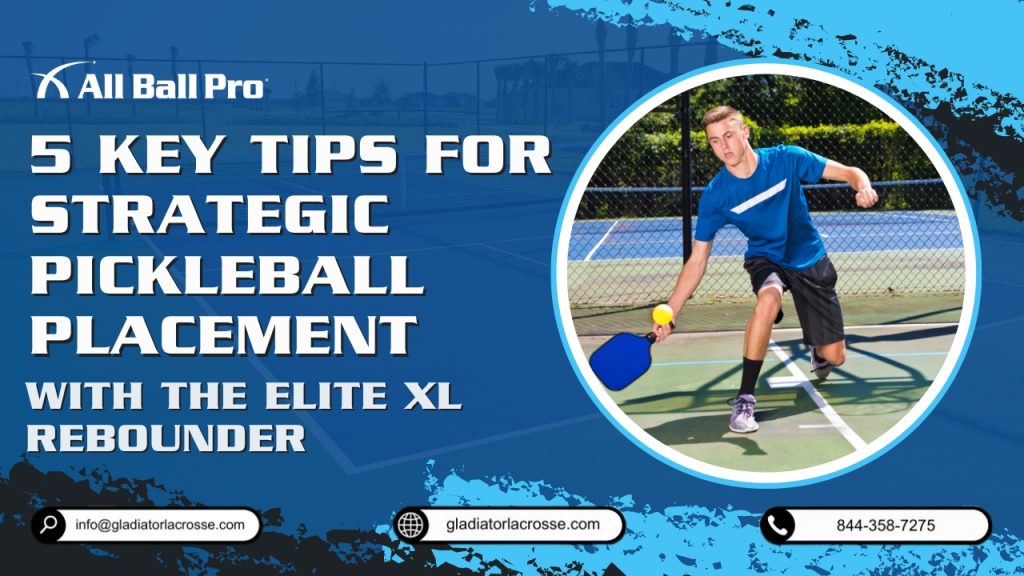
Effective shot placement is a cornerstone of Pickleball strategy. The ability to control your shots and position the ball precisely can give you an edge over your opponents. Practicing with tools like The Elite XL Rebounder by All Ball Pro can significantly refine your skills. This rebounder offers consistent ball returns, making it a reliable partner for honing your placement game. In this article, we will outline five essential tips to improve your strategic Pickleball placement using practical drills.
1. Refining Accuracy with The Elite XL Rebounder
Accuracy is the foundation of strategic shot placement. The Elite XL Rebounder provides consistent returns, which is ideal for practicing targeted shots. Begin by marking a target on the rebounder to simulate specific areas of the court you want to aim for.
- Step 1: Place the rebounder at the center of the court and mark it with colored tape to represent various zones.
- Step 2: Stand at the baseline and aim for a specific zone on the rebounder, focusing on consistency rather than power.
- Step 3: Gradually move closer to the net and repeat the exercise to simulate dinks and drops.
- Step 4: Practice alternating between forehand and backhand shots to improve versatility.
- Step 5: Challenge yourself by switching targets and adjusting shot angles for unpredictability.
- Step 6: Record your practice to review your accuracy and make adjustments where necessary.
This drill builds muscle memory and enhances your precision, making you a more reliable player during matches.
2. Mastering Depth Control Through Rebounder Drills
Depth control can disrupt your opponent’s positioning and set you up for an offensive play. The Pickleball rebounder allows you to experiment with varying ball trajectories and distances.
- Step 1: Position the rebounder at an angle to mimic different court scenarios.
- Step 2: Alternate between short dinks and deep drives, focusing on ball placement near the baseline.
- Step 3: Use a controlled swing to maintain depth without sacrificing accuracy.
- Step 4: Incorporate footwork into the drill, ensuring proper positioning for each shot.
- Step 5: Gradually increase the speed and intensity to simulate game-like conditions.
- Step 6: Evaluate your depth consistency by observing the rebounder’s return angles and adjusting your technique as needed.
Consistent depth control can force your opponents to cover more ground, creating opportunities for winning shots.
3. Enhancing Cross-Court Placement
Cross-court shots are vital for exploiting angles and keeping your opponents off balance. Practicing these shots on the rebounder helps develop sharper angles and better accuracy.
- Step 1: Set the rebounder at a diagonal to mimic cross-court scenarios.
- Step 2: Focus on hitting shots that bounce near the sidelines after returning from the rebounder.
- Step 3: Experiment with varying the pace of your shots to add unpredictability.
- Step 4: Use a split step before each shot to simulate game-like movements and improve reaction time.
- Step 5: Gradually incorporate spin to add complexity to your cross-court shots.
- Step 6: Adjust your aim and technique to target specific spots, such as your opponent’s backhand.
This drill sharpens your ability to manipulate the court and control the pace of play.
4. Perfecting Dinks and Drop Shots
Dinks and drop shots require finesse and control, which can be practiced effectively with the rebounder. These shots are essential for net play and can neutralize aggressive opponents.
- Step 1: Position the rebounder near the net and lower its angle to simulate soft returns.
- Step 2: Stand close to the net and practice gentle dinks aimed at the rebounder’s lower section.
- Step 3: Alternate between backhand and forehand dinks, focusing on maintaining a low trajectory.
- Step 4: Gradually increase the pace to simulate competitive situations.
- Step 5: Practice drop shots from the baseline, ensuring they land softly within the kitchen area.
- Step 6: Review your consistency and make adjustments to your technique for better control.
By mastering these soft shots, you can effectively change the rhythm of the game and dictate the pace.
5. Developing Reaction Speed and Anticipation
Quick reactions and anticipation are crucial in fast-paced Pickleball rallies. The rebounder’s consistent returns provide an excellent opportunity to develop these skills.
- Step 1: Position the rebounder at varying angles to mimic unpredictable returns.
- Step 2: Stand at mid-court and react quickly to each ball, focusing on early preparation.
- Step 3: Incorporate split steps to improve your readiness and footwork.
- Step 4: Use a mix of forehand, backhand, and overhead shots to diversify your practice.
- Step 5: Gradually reduce your reaction time by hitting consecutive shots at a faster pace.
- Step 6: Analyze your response times and refine your decision-making under pressure.
This drill enhances your agility and ability to anticipate your opponent’s next move, giving you a tactical advantage.
Strategic shot placement is an essential skill for any Pickleball player aiming to improve their game. By incorporating these drills into your training routine, you can develop consistency and precision while adapting to different game scenarios. All Ball Pro Rebounders are designed to support such targeted practice, helping players elevate their skills naturally over time. With dedication and structured drills, you’ll be better equipped to outperform your opponents and excel on the court.